
I want to share a real-life scenario I’m seeing with increasing frequency right now:
“I’ve been with my company for years. I’ve performed well. I’ve advanced. I’m respected. And now we’re being acquired, and the acquiring company already has someone in my role.”
This situation is becoming increasingly common, particularly at the VP and executive levels. And while every merger is different, the issue of role overlap shows up frequently and disrupts careers regardless of performance.
I recently asked my network of industry experts how they would advise someone in this position with the goal of thinking strategically about their actions over the next 30, 60, and 90 days. The responses were candid, generous, and remarkably aligned. I’m sharing them with you here, informed by what I see every day in my work with senior leaders navigating moments just like this.
First: Pause and Reflect Before Taking Action
I know the instinct. The moment professional uncertainty appears, we feel pressure to do something—update our resume, refresh our LinkedIn, or send a flurry of “just checking in” messages to our network.
But one of the strongest themes in the advice I received was this: pause and reflect before you pivot to action. Because as uncomfortable as this moment may be, it’s also a fork in the road, and how you use it matters.
Before you polish your resume or start networking in earnest, I encourage you to step back and reflect on three simple questions:
- Who am I?
- What do I want to do next?
- Why do I want to do it?
Is the right next move a step up? A lateral shift? A new industry? An adjacent role that leverages your leadership skills in a different way?
If you don’t answer these questions now, it’s very easy to default into another version of the same role, only to wake up years later wondering how you got there.
This is also the moment to get clear on your financial reality so you can build a plan that aligns with it. Ask yourself:
- If my income went away tomorrow, how long could I maintain my current lifestyle?
- At what point would I need to make meaningful changes?
Runway equals leverage, and leverage changes how you show up in interviews, negotiations, and decisions. The more prepared you are financially, the less likely you are to feel pressured into accepting a role that isn’t truly right for you.
Once you’ve done this grounding work, you’re ready to move into action. Here’s how I’d think about the next 90 days.
Days 1–30: Stabilize, Prepare, and Gather Facts
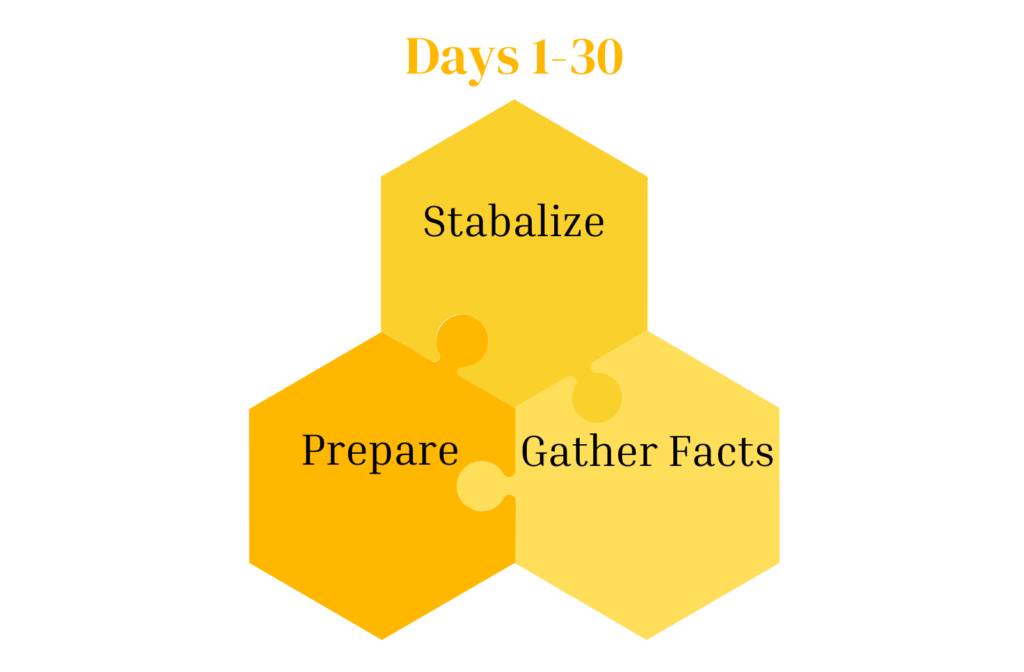
When uncertainty hits, it’s tempting to take your foot off the gas or quietly check out. My strongest advice in this first phase is simple: Do not mentally resign.
Nearly every experienced leader who weighed in offered some version of the same guidance: do your job well right now. That means continuing to show up as a steady presence, supporting your team, and—this came up repeatedly—not gossiping, no matter how tempting it may be when information feels scarce.
How you behave during a transition becomes part of your professional reputation, both internally and externally. The people you work with right now are part of your long-term network, and you may need their support one day if you decide to make another move.
If you need to vent, do it in a truly safe space: with a partner, coach, or trusted confidant outside the organization. Avoid turning colleagues into sounding boards for uncertainty.
At the same time, this is the moment to prepare—quietly and intentionally.
Document Your Value
If you’ve been at your company for years, much of your proof of impact lives inside systems you may not have access to forever. Start collecting what one contributor affectionately called your “atta boys”:
- Emails thanking you for your work
- Performance reviews and written feedback
- Metrics, results, and outcomes
- Evidence of programs built, teams scaled, revenue protected, or change led
This isn’t just job-search collateral. It’s also a powerful confidence booster when things feel uncertain—a tangible reminder of the value you’ve delivered.
Update Your Career Brand (Discreetly)
This is about readiness, not about making a big announcement to your network that you’re seeking a new opportunity.
Many leaders I work with have been in the same role or at the same company for years, and their career documents haven’t kept pace with their growth. Now is the time to refresh your career brand so you’re not scrambling later when a recruiter asks for your resume.
This is also where you can lean on the reflection you’ve already done to make sure your career documents reflect the direction you want to go for your next opportunity
I recommend:
- Updating your resume to include your current role, recent quantifiable results, and any new certifications or accolades.
- Refreshing your LinkedIn profile so it reflects your seniority and scope.
- Clarifying your leadership narrative:
- What results are you most proud of?
- What challenges have you navigated?
- What are you known for?
- What results are you most proud of?
- Practicing networking conversations with close, trusted contacts. Frame your goal as exploring options, not running from a fire.
Get the Lay of the Land Internally
One of the biggest mistakes leaders make is waiting for official clarity on what’s next for them. But by the time clarity arrives, any leverage you had is often gone.
Instead of waiting to be told what’s coming next, pay close attention to what’s happening around you and how it relates to your role. For example:
- Who’s being pulled into conversations?
- Who’s receiving retention bonuses?
- Does your work require institutional knowledge that has value for a specific period of time?
Staying aware and gathering facts early puts you in a far stronger position to make thoughtful decisions later.
Days 31–60: Create Optionality, Internally and Externally
By and large, the advice I received centered on the importance of creating options for yourself. You want to be the one making a decision, not waiting for someone else to make it for you.
Here’s how to ensure you have choices available to you:
Begin a Discreet Market Scan
Think of this less as a public job search and more as information gathering. The goal here is to understand your options before you need them.
That means:
- Reconnecting with a broader group of trusted former managers, peers, and senior colleagues.
- Having confidential conversations with recruiters who understand your market.
- Testing how your experience, leadership scope, and results are being valued right now.
As one contributor put it, keeping one foot in the marketplace helps you avoid scrambling later, and allows you to make decisions from a place of strength rather than urgency.
Stay Engaged Internally
At the same time you’re testing the waters externally, continue investing in relationships inside the evolving organization. Introduce yourself to incoming leaders. Share context and perspective. Look for opportunities to add value during integration.
You never know what will happen; sometimes the acquiring company chooses the stronger leader, regardless of original org chart assumptions. Don’t disqualify yourself prematurely.
Protect Your Energy
Things can feel chaotic leading up to a merger or acquisition, so guard your time and bandwidth strategically.
Delegate thoughtfully. Advocate for emerging talent to take on more responsibility. Begin writing recommendations for colleagues—especially those on your team—who may also be navigating uncertainty. Goodwill compounds, and people will remember how you treated them during moments like this.
Days 61–90: Decide From Strength, Not Fear
By now, the work you’ve done—staying engaged, gathering data, and building optionality—should be paying off. Patterns will be emerging, whether or not anyone has said anything explicitly.
This is the moment to ask yourself, honestly and without judgment:
- Am I being pulled into future planning, or quietly sidelined?
- Are my relationships within the organization expanding or narrowing?
- Do I feel like I’m choosing to stay, or defaulting to what feels safe?
The answers to these questions will help you move from reacting to what’s happening around you to proactively choosing from the options you’ve created.
If You Stay, Make It a Choice
If staying is the right move, negotiate intentionally to ensure you feel good about the role’s scope, impact, growth potential, and financial upside.
In some cases, this may mean proposing a redefined role that aligns more closely with what the new organization prioritizes. Staying should feel like a strategic decision, not an unexamined default.
If You Leave, Exit With Leverage
If it’s clear your role is being steered around, be ready—and advocate for yourself.
That may include asking for:
- Executive-level career coaching rather than standard outplacement
- A thoughtful severance package
- Time and space to transition well
Leave on strong terms. Collect referrals and recommendations. Write thank-you notes. How you exit matters, because reputation is long-term capital.
Common Mistakes to Avoid

Across all the advice I received, a few cautions surfaced again and again:
❌ Waiting for certainty
❌ Oversharing internally
❌ Gossiping instead of gathering facts
❌ Assuming performance equals protection
❌ Letting anxiety close doors too early
❌ Burning bridges
This moment doesn’t require panic. It requires intention.
Final Thoughts: Disruption Can Be an Opportunity–Even When It Doesn’t Feel Like It
While mergers are undeniably destabilizing, they also create rare windows for reflection and repositioning. This is an opportunity to clarify what matters most to you, to leverage your experience leading through change, and to ensure that whatever comes next is something you actively choose.
If you have three months of runway, you have time. And with the right approach, you also have agency.
If you’re looking for a strategic partner in the process, this is exactly the kind of work we do at Briefcase Coach: helping senior leaders clarify their direction, articulate their value, and position themselves for what’s next—whether that’s staying put for the right reasons, or moving on to the next opportunity with confidence.